


Janes All The Worlds Aircraft 1952-53
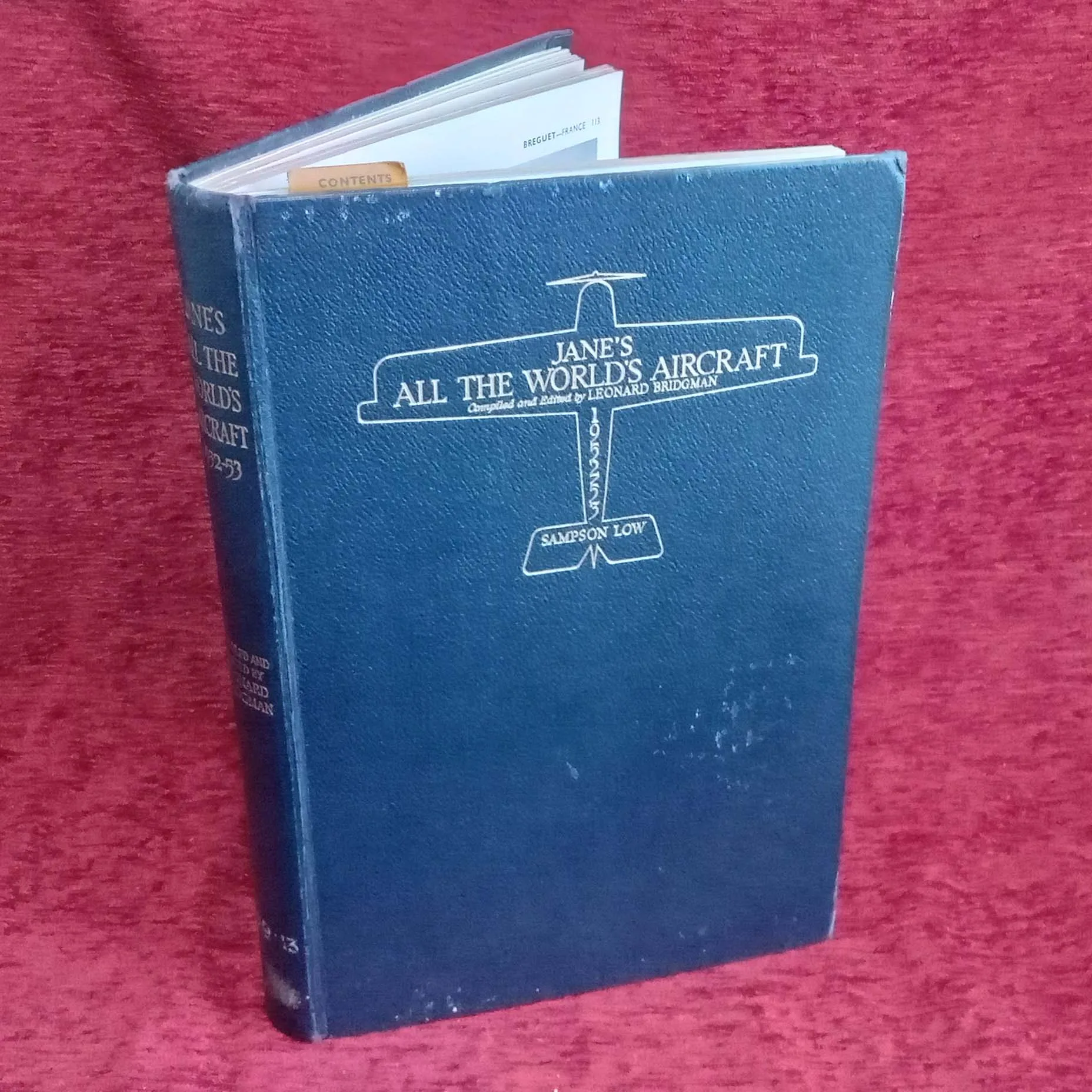
Publisher: Janes
Format: Hardback
ISBN: none
Jane’s All the World’s Aircraft 1952–53 (1953)
By Jane’s
Publisher: Jane’s — ISBN: none
Condition: Fair (ex-library)
As sold by Crappy Old Books
There are reference books, and then there are volumes like Jane’s All the World’s Aircraft, which do not so much sit on a shelf as occupy it with official intent. The 1952–53 edition comes from a particularly marvellous period in aviation history, when the world was still digesting the lessons of the Second World War while simultaneously hurtling into the jet age with a mixture of brilliance, optimism, and the occasional aluminium-based overconfidence.
This is not a book for those who merely “quite like planes.” This is a book for the sort of mind that sees an aircraft and immediately wants to know its engine type, wingspan, cruising speed, production history, and perhaps whether the prototype embarrassed itself on first testing. Jane’s has long been the gold standard for this sort of thing: sober, comprehensive, technically minded, and gloriously indifferent to whether the casual reader might prefer a little more drama and a little less data. The drama, after all, is in the data.
And what data. The early 1950s were a golden age of aeronautical transition. Some nations were clinging nobly to polished propeller-driven designs, while others were embracing jets with the fervour of people who had looked at the future and decided it ought to be faster, louder, and considerably more expensive. Within these pages lies that exact moment of overlap: a worldwide inventory of aircraft that captures aviation mid-metamorphosis. One can practically hear the propellers fading and the jet turbines clearing their throats.
Naturally, there is something deeply satisfying about the confidence of a book that sets out to catalogue all the world’s aircraft. Not some aircraft. Not notable aircraft. Not even merely many aircraft. All of them, or at least enough to make the attempt feel gloriously audacious. This is publishing at its most admirably stern: a large, serious volume assembled for readers who believed information should be comprehensive, structured, and printed on paper sturdy enough to survive years of consultation.
This particular copy is ex-library, which feels entirely appropriate. A book like this belongs to a life of service. One imagines it standing dutifully on a reference shelf, occasionally summoned by someone with a practical question about a Hawker, a Douglas, a de Havilland, or some obscure machine designed in a burst of national ambition and later forgotten by everyone except the truly committed. Library markings and signs of use only add to the atmosphere. They suggest the book has done what it was made to do, which is far more honourable than sitting untouched and pristine while contributing nothing to civilisation.
Its Fair condition also suits it rather well. Jane’s was never intended to be dainty. This is a working book, a handbook for the mechanically curious, the technically inclined, and the sort of reader who gets genuine pleasure from a carefully printed specification table. A little wear simply confirms that it has been handled by people who understood its value. In the hierarchy of old books, “slightly worn but obviously useful” is often a much more attractive category than “immaculate and suspiciously unloved.”
For the modern reader, the appeal is enormous. Beyond its value as a reference source, this edition is a time capsule of postwar engineering ambition. Here are aircraft built for commerce, conflict, prestige, transport, experimentation, and national self-belief. Some would become icons. Some would vanish into footnotes. All of them once represented someone’s idea of what the skies should contain. There is something wonderfully moving in that: the whole airborne imagination of the early Cold War spread out in orderly form.
And of course there is a quiet irony in the fact that a book so dedicated to motion should be such a hefty, static object. Aeroplanes are about speed, lift, escape, horizon. Jane’s is about pinning them all firmly to the page and demanding that they submit their dimensions. It is the bureaucratic side of wonder, which is perhaps the most British thing imaginable.
In short, Jane’s All the World’s Aircraft 1952–53 is a magnificent slab of aviation history: authoritative, obsessive, practical, and strangely elegant in its seriousness. This 1953 ex-library copy, in Fair condition, has all the right signs of a life well used and much consulted. An excellent acquisition for aircraft enthusiasts, collectors of technical reference works, historians of flight, or anyone who finds deep comfort in the idea that somewhere, someone once attempted to list every flying machine on earth and very nearly managed it.
Keep browsing: See more Transport books Other books by Janes
